By Karolina Markusson, Policy and Outreach Officer, the Solar Stewardship Initiative
The European Union is introducing a growing number of regulatory and policy initiatives aimed at strengthening sustainability, resilience and responsible business conduct across its value chains. From the Forced Labour Regulation (FLR) and the Corporate Sustainability Due Diligence Directive (CSDDD) to sustainability requirements in public procurement and the Net-Zero Industry Act (NZIA), companies operating in the solar sector face increasing expectations to understand, monitor and improve sustainability performance throughout their supply chains.
While no certification or multi-stakeholder initiative can replace legal obligations, official guidance to due diligence legislation recognises the role that multi–stakeholder initiatives like the Solar Stewardship Initiative (SSI) can play as practical tools to support companies in implementing responsible sourcing practices, strengthening due diligence processes, and demonstrating continuous improvement.
The EU Forced Labour Regulation
The EU Forced Labour Regulation (FLR) prohibits products made with forced labour to be sold in or exported from the EU market. Now is the time for businesses to prepare, as the Regulation becomes applicable and enforceable in December 2027.
The FLR requires companies to understand and address forced labour risks within their operations and supply chains. Businesses must be able to demonstrate that they have taken appropriate steps to identify, prevent, mitigate and bring to an end forced labour risks.
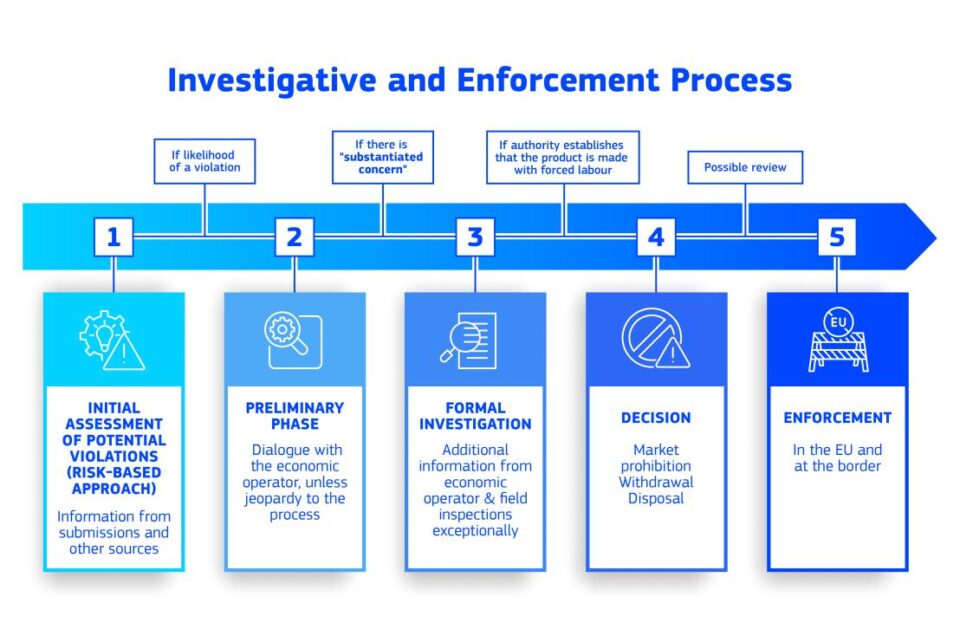
The European Commission will investigate cases of suspected forced labour outside the EU, while EU Member States’ national authorities handle cases within their territories. Authorities will prioritise high-risk products and geographies in their investigations. The initial assessment of a potential violation will be done through a risk-based approach where information from submissions and other sources will be taken into account. If there is a likelihood of a violation, authorities will start a dialogue with the suspected company, unless this poses a risk to the process. If at this stage, there is a substantiated concern, authorities will launch a formal investigation requesting additional information from the company. If the authorities establish that the product is made with forced labour, they may decide to prohibit the product on the European market, withdraw it, or dispose of it. In this case, custom authorities enforce decisions to ban a product at the EU’s external borders, and there may be penalties for non-compliance of this ban.
Where the SSI can fit in
As forced labour risks extend across multiple tiers of the supply chain, collaborative approaches are increasingly recognised. Through the SSI, buyers, manufacturers, civil society, international financial institutions and other actors can work together, share knowledge and strengthen collective leverage to address challenges that individual companies may struggle to tackle alone. The European Commission’s guidance to the Regulation highlights the important role multi-stakeholder initiatives can play in helping companies manage forced labour risks.
In an investigative process, competent authorities, like the European Commission, can request companies to provide information on their actions to identify, prevent, mitigate and end risks of forced labour. The official guidance shares examples of the types of information authorities might request, such as documentation showing participation in multi-stakeholder initiatives or industry certification schemes, corrective action plans, and third-party independent audit reports; all features of the SSI system. Product traceability, responsible purchasing practices, and certification schemes can also be, according to the Commission guidance, effective approaches to demonstrate that products under investigation were not made with forced labour.
Information generated through third-party assessments conducted under the SSI assurance system can also support companies’ due diligence and investigations. The SSI audit system processes many of the same points of information that a Commission investigation could consider on, including supply chain mapping and worker interviews. Therefore, preparation for audit can support preparation for a potential investigation.
The SSI also supports companies through knowledge sharing and capacity building, including the freely available SSI Buyer’s Guide. This can particularly support SMEs, which often have less resources to dedicate to due diligence work.
The EU Corporate Sustainability Due Diligence Directive (CSDDD)
The EU’s Corporate Sustainability Due Diligence Directive (CSDDD) is a vital piece of legislation as it moves responsible business conduct from a largely voluntary expectation to a clear legal duty. By requiring companies to identify, prevent, mitigate, bring to an end, and account for actual and potential adverse human rights and environmental impacts in their own operations, subsidiaries, and chains of activities, the CSDDD creates a more consistent framework for responsible supply chains.
The CSDDD will start to apply from July 2029 to EU companies with more than 5000 employees and a global net turnover exceeding €1.5 billion, and to non-EU companies generating more than €1.5 billion in turnover within the EU market.
Where the SSI fits in
The CSDDD emphasises risk-based due diligence, stakeholder engagement, and continuous improvement. Through its multi-stakeholder governance model, the SSI brings together companies, civil society, and other stakeholders to strengthen risk identification, facilitate dialogue, and support effective corrective action. The SSI also enables collective action, allowing companies to share knowledge, align expectations, and exercise leverage more effectively than they could individually. This can help reduce duplication, lower implementation costs, and address systemic challenges that extend beyond the influence of any single company.
The CSDDD explicitly recognises the role of multi-stakeholder initiatives in supporting businesses operating in the EU to understand and meet their due diligence requirements. The SSI recently responded to the public consultation on the CSDDD guidelines, where we broke down the key fitness criteria that the Commission should consider when evaluating the robustness of a multi-stakeholder initiative system. Using the SSI case study, we set out how sector-specific ESG & traceability Standards and independent third-party verification processes can help companies identify and assess risks, improve supply chain visibility, and gather reliable information on potential human rights and environmental impacts. You can find the full submission to the guidelines on the SSI website.
By supporting traceability, supplier capacity building, independent assessment, and continuous improvement, the SSI can serve as a practical tool to support companies in implementing and strengthening their due diligence processes.
The Net-Zero Industry Act (NZIA)
The Net-Zero Industry Act (NZIA) is a piece of legislation designed to strengthen Europe’s clean technology manufacturing base and support the diversification of supply chains for strategic net-zero technologies, including solar PV products.
NZIA has been in force since the beginning of 2026, and under the Regulation, at least 30% of public renewable energy auctions would be subject to the new rules. SolarPower Europe estimates that this could create around 60 GW of NZIA auction demand through to the end of the decade.
While it is not a traditional supply chain sustainability law, the NZIA does introduce new sustainability and responsible business conduct requirements into solar auctions and public procurement.
Where the SSI fits in
The text of NZIA’s implementing legislation states that third-party assurance can support compliance with the pre-qualification criteria on responsible business conduct. On top of the legal text, the Implementing Guidelines for the NZIA Auctions suggest that authorities should apply the principles of the CSDDD to their auction design and larger public tenders. Through its standards, independent third-party assessment, and traceability requirements, the SSI helps companies strengthen supply chain transparency and provide credible information about how solar products are sourced and manufactured.
Because the SSI Standards and assurance system are globally applicable, they can be used across different manufacturing regions and supply chain tiers, helping companies to apply consistent expectations across increasingly diverse and international supply chains.
Public Procurement and Sustainability Requirements
Public procurement is increasingly being used as a policy tool to drive sustainability and responsible sourcing across supply chains. Across Europe, public authorities are exploring ways to integrate sustainability, human rights and resilience considerations into procurement decisions, including for renewable energy technologies, giving companies investing in due diligence, sustainability and transparency an advantage.
In September 2026, the European Commission published its proposal for a new Public Procurement Act, which would replace and consolidate the three existing EU public procurement directives into a single, simplified legislative framework. The proposal aims to modernise procurement rules, reduce administrative burden, and strengthen the ability of public authorities to take account of sustainability, resilience and broader public policy objectives when awarding contracts.
The proposal reflects a broader shift in EU policy, where the value of a product is not only assessed on cost and technical performance, but increasingly on the wider associated impacts. This includes considerations linked to environmental sustainability, responsible business conduct, supply chain transparency, resilience, and compliance with applicable social and labour standards. For sectors such as solar energy, where public purchasing and public support schemes play a significant role in market development, these evolving requirements are likely to increase expectations on companies to demonstrate responsible sourcing practices and greater visibility throughout their supply chains.
Where the SSI can fit in
As public authorities place greater emphasis on sustainability, traceability and responsible sourcing, companies will increasingly need credible ways to demonstrate that they understand and manage risks within their supply chains. The SSI can support companies by providing a sector-specific framework for assessing and improving environmental, social, and governance performance across solar value chains.
Notably, the European Commission report Incentivising Responsible Business Conduct Through Public Procurement explicitly references the Solar Stewardship Initiative as an example of a credible sector-specific initiative that public buyers could incentivise through procurement. In a case study on solar supply chains, the report suggests that public authorities could encourage suppliers to join the SSI, or an equivalent initiative, and use procurement criteria that reward enhanced traceability, transparency, and responsible sourcing practices in the solar sector. It highlights the SSI as a potential tool for supporting efforts to prevent and mitigate forced labour risks while improving visibility further upstream in solar supply chains.
The SSI’s globally applicable standards and assurance system are particularly relevant in a procurement environment that increasingly values supply chain resilience and diversification. By providing a common framework that can be applied across different countries, manufacturing regions, and supply chain tiers, the SSI enables companies to demonstrate consistent expectations and comparable performance across solar supply chains. This can help reduce duplication for both suppliers and buyers while supporting a more harmonised approach to responsible sourcing in public procurement.

Offering practical tools for an evolving landscape
The European regulatory environment for the solar sector is evolving rapidly. While legislation establishes the obligations, companies need practical tools to implement them effectively. By providing Standards, assurance processes, traceability tools and a collaborative platform for industry and civil society engagement, the SSI can help companies strengthen the systems and practices that are increasingly expected under EU policy and legislation.
No single initiative can guarantee compliance with legal requirements. However, participation in credible, collaborative and independently assessed systems can play an important role in helping companies prepare for a future in which responsible sourcing is not only expected, but increasingly required.